Who Is Buried in the Paris Catacombs? History, Numbers and Myths
Six million Parisians, a 1786 consecration, a secret cinema and the man lost for eleven years: the history of the Paris Catacombs, checked against the sources.
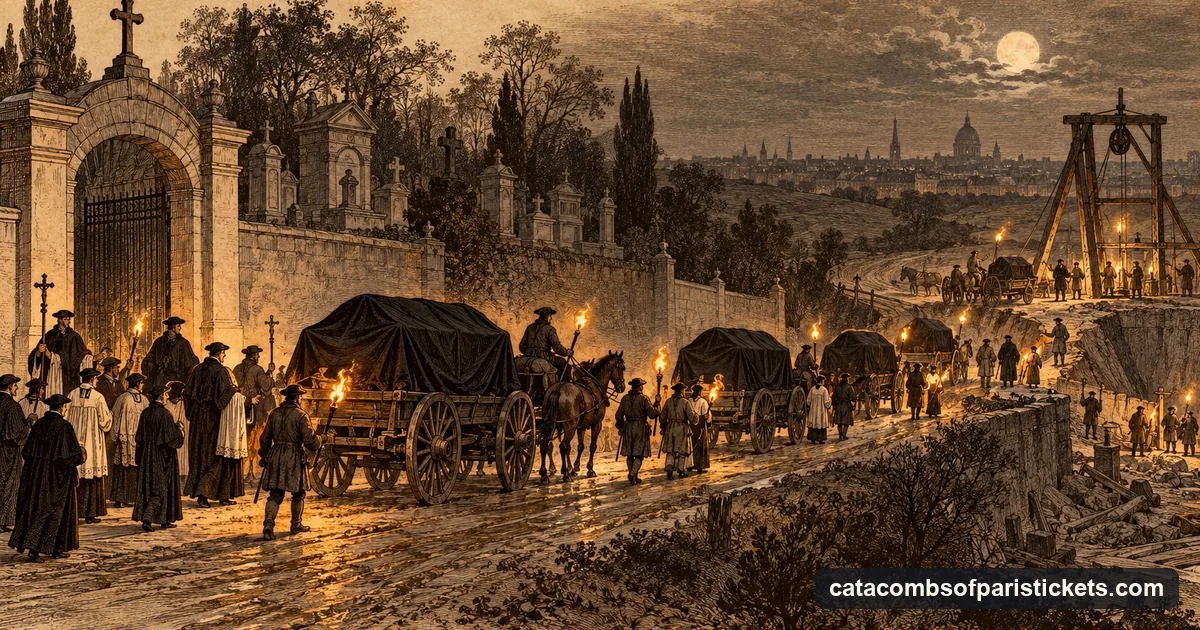
About six million people lie in the Paris Catacombs, none of them in a grave of their own. They were Parisians who had been buried in the city’s parish cemeteries over roughly a thousand years, and who were dug up and moved underground from 1785 onwards because those cemeteries had become a public health disaster. The ossuary we visit today is the result.
Why the bones were moved
By the late 18th century the cemeteries inside Paris were full. The largest, the Saints-Innocents in the heart of the city, had been taking the dead for centuries, and its walls and the cellars around it were giving way. The authorities decided to empty it and the other parish cemeteries into a place outside the city: the abandoned Tombe-Issoire limestone quarries under the plain of Montrouge, now the 14th arrondissement.
According to Paris Musées, the first transfers ran from 1785 to 1787 and concerned the Saints-Innocents. The site was consecrated as the Paris Municipal Ossuary on 7 April 1786, and the name “Catacombs” came later, borrowed from the Roman catacombs that fascinated the public at the time. Transfers paused during the Revolution, resumed in 1800 and continued on and off until 1860, as Paris’s great rebuilding cleared more cemeteries.
How the walls of bones came about
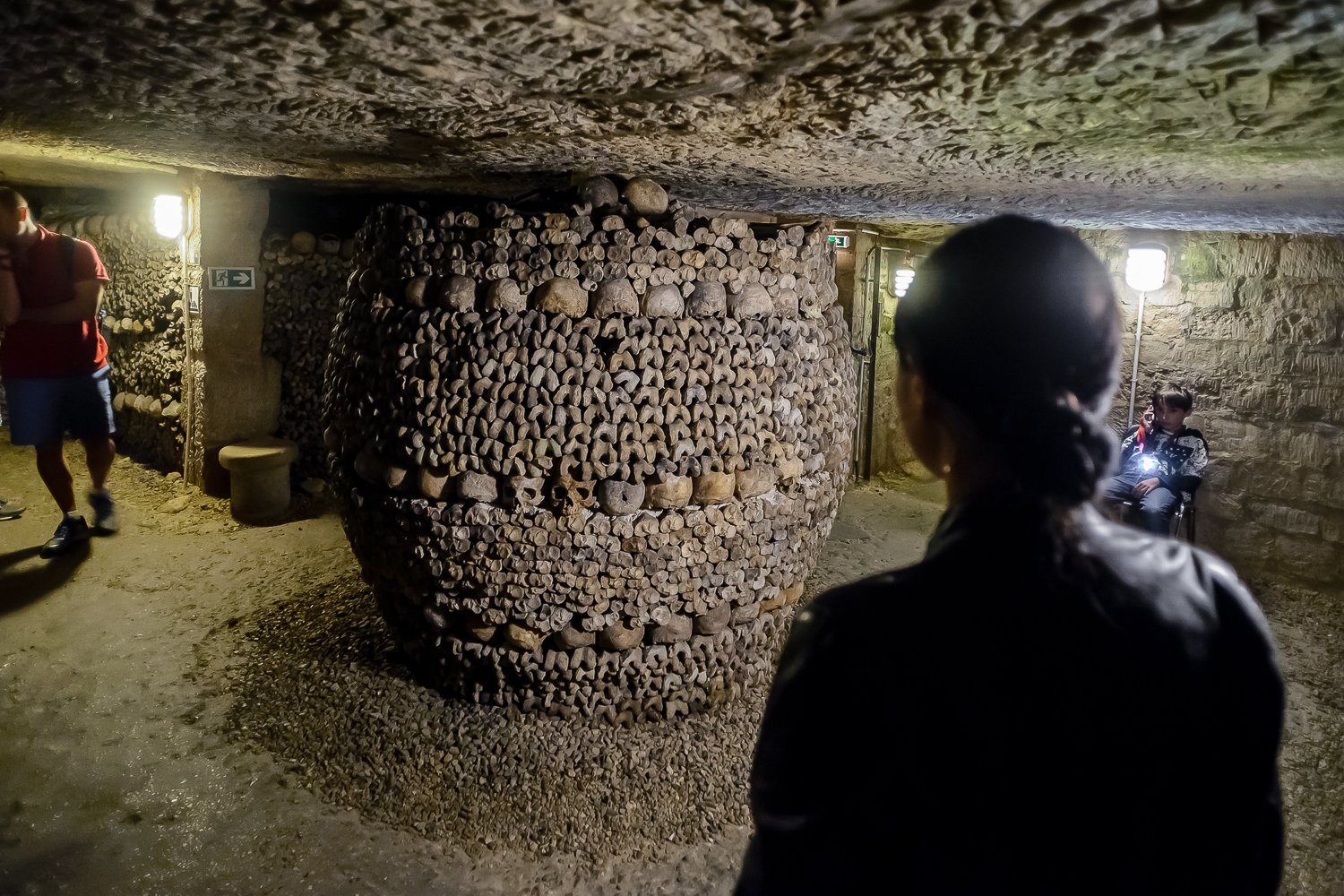
At first the bones were simply dumped. The arrangement you see today is the work of Louis-Étienne Héricart de Thury, the inspector of the quarries, who between 1810 and 1814 had them stacked into walls of femurs and tibias with lines of skulls, and added plaques naming the cemetery each section came from, plus inscriptions on death. The Catacombs had opened to visitors by appointment in 1809, and his arrangement was meant for them.
The quarries around it
The ossuary is a small part of something much bigger. Paris was built from the limestone beneath it, and the quarry galleries under the south of the city run to roughly 300 km. Only the 1.5 km museum route is open. Entering the rest has been illegal since 1955, and a special police unit patrols it. The visitable site covers about 11,000 square metres, 20 metres down, the depth of a five-storey building.
The stories, and which ones hold up
The man who got lost
Philibert Aspairt, a doorkeeper at the Val-de-Grâce hospital, is said to have gone into the quarries in 1793 and never come out. His body was found in 1804, and a tombstone marks the spot in the tunnels. The details vary from telling to telling, but the story is old and the stone is real.
The secret cinema
True. In 2004 the police found a fully equipped cinema and bar in a cavern under the Trocadéro, with a screen, seating, projection equipment and a stock of films. A group of underground explorers took responsibility for it.
People still get lost
True, in the illegal part of the network. In June 2017 two teenagers aged 16 and 17 were rescued after three days lost in the tunnels and treated for hypothermia, reported by the BBC and The Guardian. It is the clearest reason the museum route exists.
How many murders?
The murder and disappearance stories that circulate online mostly concern the closed quarries, not the museum route, and many are retellings of the same few cases. The real dangers down there are the ordinary ones: flooding, collapses and getting lost.
Six million, in context
That is more than the number of people living in Paris today. There are no names on the bones and no way to identify individuals; the plaques tell you only which cemetery a section came from and when. Visitors walk past them in about an hour. To see the ossuary for yourself, book a Catacombs ticket, or read whether the Catacombs are worth it first.
Seeing It for Yourself
More Ways to See Paris Underground and After Dark
Live availability for Catacombs tickets, guided tours and other Paris experiences.
Secure Your Catacombs Entry — Before the Slots Go
Tickets are released only 7 days ahead and regularly sell out. Book the timed-entry ticket with audio guide, rated 4.6/5 from 12,405 reviews and from $43 as of October 2026, and walk down with your slot confirmed.
Check Availability & Book